Four directions I explored
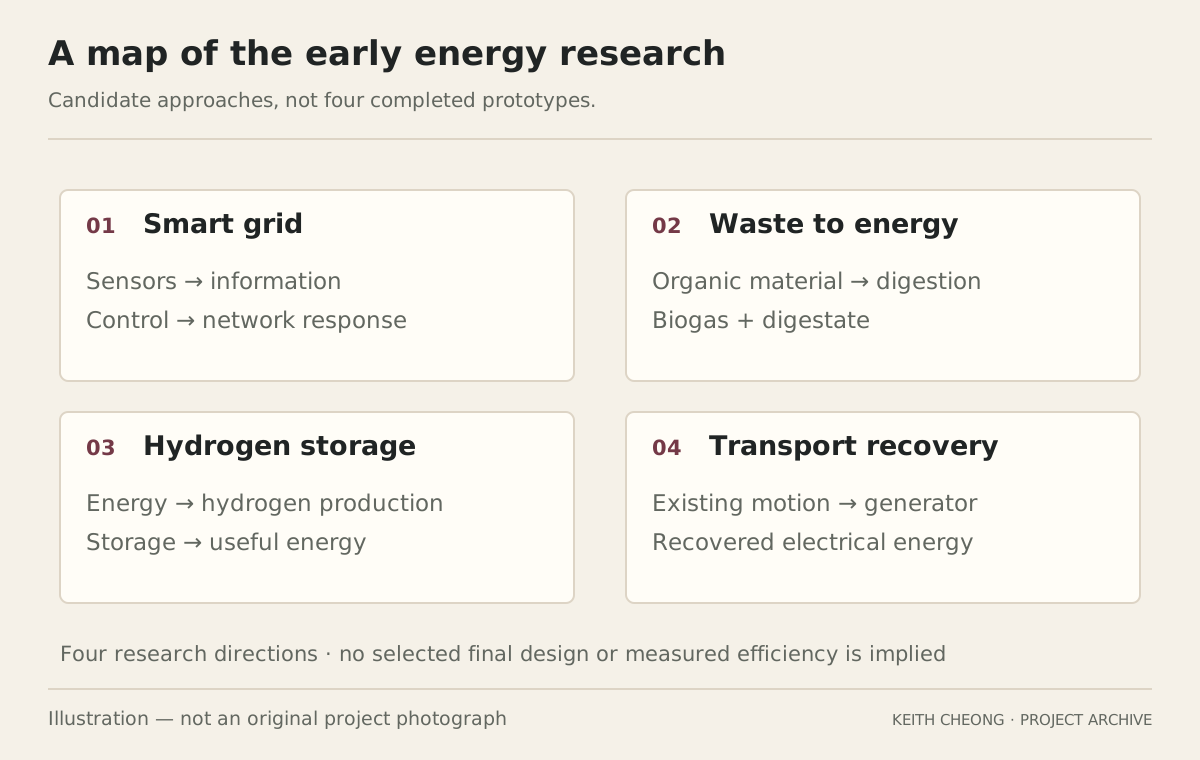
The early research considered ways to improve energy use through sensing, control, conversion and recovery. These were candidate directions, not four completed projects.
- Smart grids: sensors, communication and control to help monitor and manage electricity networks.
- Food waste to energy: anaerobic digestion of organic material and possible use of the resulting biogas.
- Hydrogen storage: producing an energy carrier that can later supply useful energy.
- Transportation recovery: investigating whether part of existing motion or braking energy could be recovered.
Keeping the energy story accurate
DOE describes smart grids in terms of sensing, communication, control and computing. EPA explains that anaerobic digestion breaks down organic material without oxygen and can produce biogas, mainly methane and carbon dioxide.
Hydrogen is an energy carrier: energy must be supplied to produce it. An energy-storage concept therefore needs to account for production, storage and conversion, not just the final electricity output.
Likewise, transport energy recovery is not energy creation. Electric vehicles can use motor-generators for both propulsion and regeneration; a proposed recovery device still needs a clear account of where its input energy comes from.
The competition outcome
My entry was not selected. The current record does not establish which research direction became the final submission or whether a prototype was built. I am keeping that boundary visible rather than filling it with a reconstructed claim.
How I would evaluate a next concept
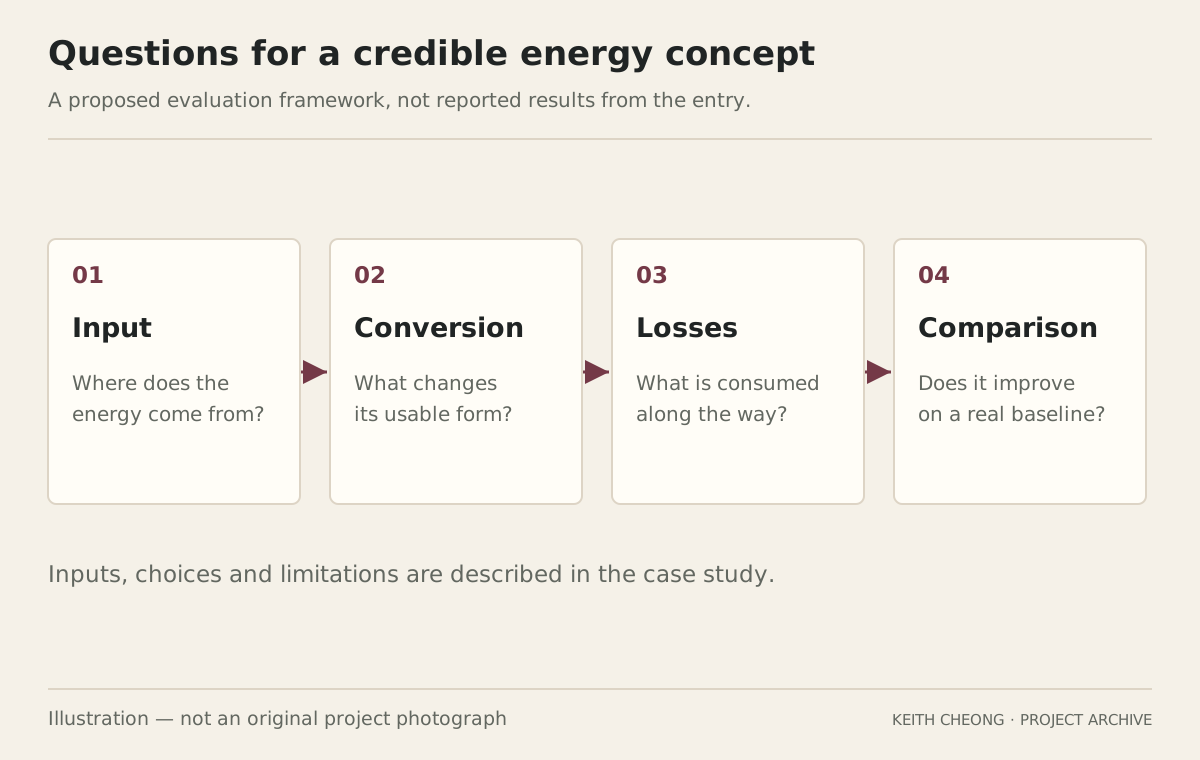
A useful next step would be to choose one narrow problem and compare an idea with a realistic baseline. I would identify the energy input, useful output, losses, cost and practical constraints before making an efficiency claim.
The diagrams on this page are concept maps. They contain no measured performance values and do not depict a completed competition prototype.