Project 05 / 09 · Biology · Research synthesis · Visual communication
Stem Cells Research Poster
The design challenge was to make a complex biology topic readable without losing the distinctions that make it scientifically accurate.
Stem-cell biology
Research
A3 poster
Scientific communication
Original recordResearch and poster design recorded
This presentationIllustrated research summary
The archive documents the research topics and poster requirements. It does not establish a laboratory experiment, a clinical intervention or an assessed final poster result.
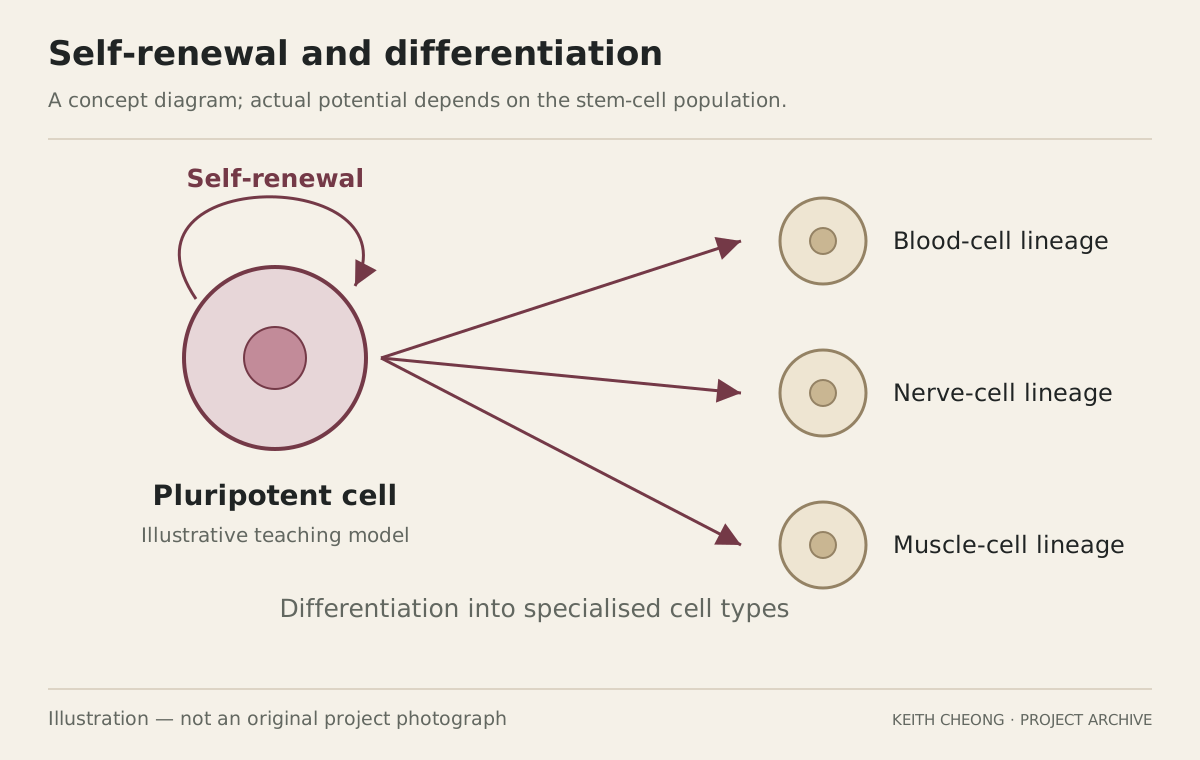
An overview of the idea and its boundaries.Illustration — not an original project photograph
I organised the subject around self-renewal, differentiation and potency. The archive also records work on OCT4, SOX2 and NANOG, alongside the Wnt, Notch and Hedgehog signalling pathways.
The potency terms I studied were totipotent, pluripotent, multipotent and unipotent. The important distinction was that different cell populations have different developmental possibilities; 'stem cell' is not a single interchangeable cell type.
02
The scientific distinctions
Self-renewal maintains a stem-cell population, while differentiation produces more specialised cells. NIH distinguishes pluripotent cells, which can form the cell types of the adult body, from adult stem cells with more tissue-specific capabilities.
Primary research by Boyer and colleagues identified interconnected regulatory roles for OCT4, SOX2 and NANOG in human embryonic stem cells. I used the topic to connect gene regulation with cell identity, without reducing all differentiation to one universal switch.
03
Applications and evidence
My reading included blood-forming stem-cell transplantation, corneal repair and wider regenerative-medicine research. These topics do not all have the same maturity or apply to every cell type and condition.
The poster also considered tumour formation, immune rejection and ethical questions. The ISSCR distinguishes approved, investigational and unproven interventions; a promising laboratory result is not by itself evidence of a safe, effective treatment. This page discusses the research topic and offers no treatment guidance.
04
Turning research into a poster
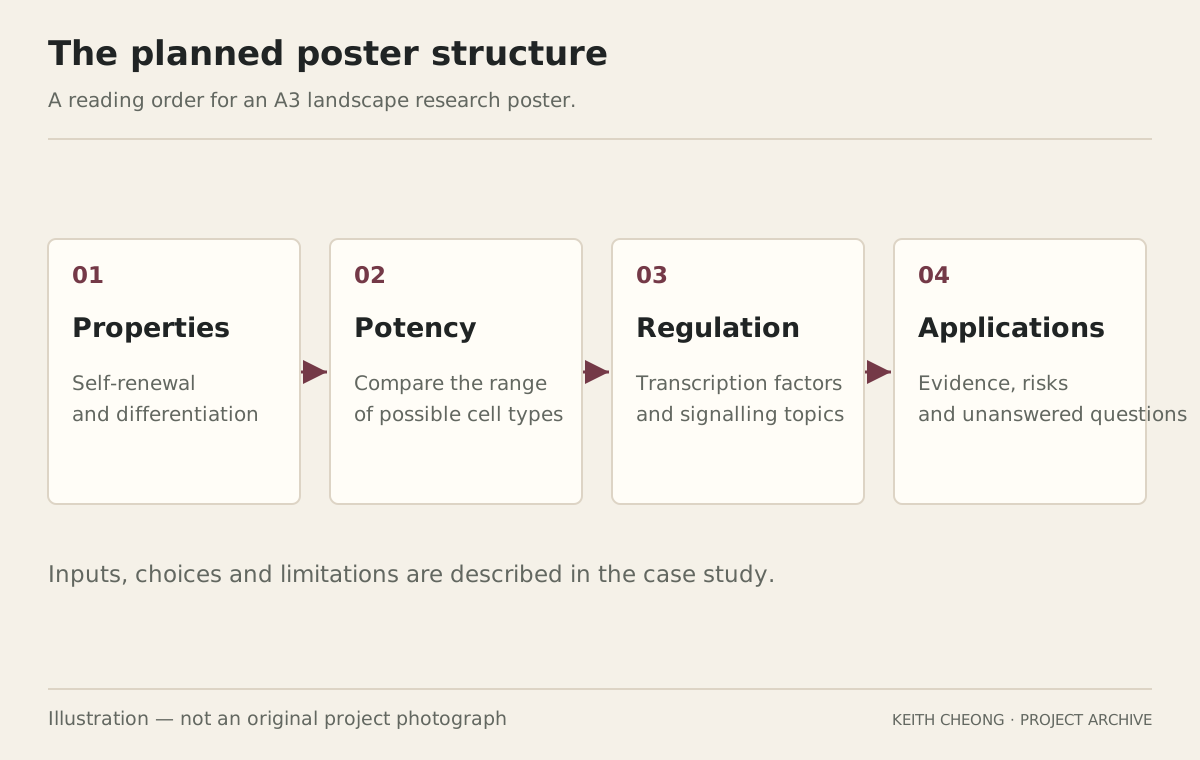
The A3 landscape brief put scientific accuracy first. I planned a progression from basic properties to regulation and applications, using visual groups and short explanations so a reader could follow the argument.
The figures on this page are new explanatory diagrams. They are not photographs of a laboratory result or a reproduction of a verified final submitted poster.
A reading order for an A3 landscape research poster.Illustration — not an original project photograph
Distinguishes approved, investigational and unproven interventions and discusses risks.
About this record
Project scope and poster requirements come from my supplied My Project Archive. The references support the scientific background; no medical recommendation is made.
All diagrams on this page are newly made explanatory illustrations. They do not replace original photographs, test results or source files.